

Dollar General: A Subtle Masterclass in Reading the Room
The Handoff, the Valuation Gap, and What the Stores Confirm | Narrative Integrity Diagnostic, Part 1 of 2

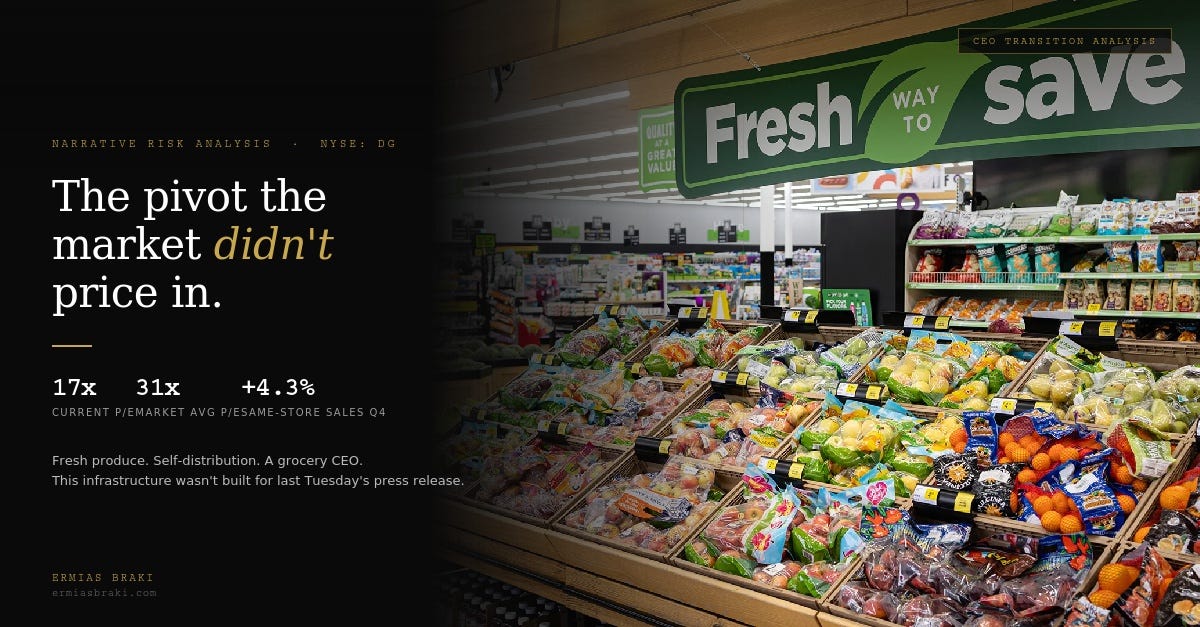
On March 24, 2026, Dollar General’s board announced that JJ Fleeman, current CEO of Ahold Delhaize USA, would succeed Todd Vasos as Chief Executive Officer effective January 1, 2027.
The stock dropped 5%.
The board called Vasos’s tenure a story of transformative change, accelerated growth, and a disciplined return to retail fundamentals. The market processed the press release at face value. One session. Then moved on.
That is where this diagnostic begins.
The Announcement Is Not a Succession Story
It is a proof of concept story. For a strategy that has been years in the making, arriving at the exact moment the macro environment is building the customer for it.
DG Fresh, Dollar General’s self-distribution system for frozen and refrigerated goods, launched in 2019. Fresh produce is now in more than 7,000 stores. Delivery through DoorDash and Uber Eats covers more than 17,000 locations. The DG app has real loyalty traction. The DG Media Network is an emerging retail media asset.
None of this was built for a press release.
JJ Fleeman spent years at Peapod Digital Labs building the omnichannel and loyalty infrastructure that now underpins Ahold Delhaize USA across Food Lion, Giant, Hannaford, and Stop and Shop. His profile maps onto what Dollar General has been quietly constructing for the better part of a decade. The hire is not a departure from the strategy. It is the strategy naming itself.
Announcing the transition nine months early, during broad market turbulence, was deliberate. The 5% drop gets absorbed in the noise of a down market instead of standing alone as a signal of board concern. By January 2027, the market will have had three quarters to watch the thesis validate itself in the numbers.
That is a sequencing decision. Not a communications one.
The Capital Record
The board’s handoff language credits Vasos with a strong trajectory. That framing is worth measuring against what actually happened with capital.
In fiscal 2022, Dollar General spent $2.55 billion on share repurchases. In fiscal 2023, $2.748 billion. Then nothing. Every quarter of fiscal 2024 reported zero repurchases. Guidance assumed no buybacks in fiscal 2025. The remaining $1.4 billion authorization sat untouched for more than two years.
There is a detail in the filings that did not make the press release. A March 2025 amendment to Dollar General’s credit agreement explicitly restricted share repurchases until at least January 30, 2026. Lenders required it. The suspension was not purely strategic. Financial ratios were strained enough to require covenant relief.
A company spending $2.7 billion annually on buybacks one year and drawing lender-mandated repurchase restrictions two years later is not straightforwardly described as executing a disciplined return to retail fundamentals.
The stabilization is real. The characterization of it requires precision.
The Shrink Arc
Language is data. The shrink narrative at Dollar General over the past three years is a clean illustration of how the same operational problem gets named differently depending on who is speaking and what the moment requires.
August 2023, under CEO Jeff Owen: the CFO told analysts the shrink environment had continued to worsen and flagged $100 million of additional headwind since the prior quarter. Owen was replaced within weeks. Vasos returned.
December 2023: the same CFO said shrink had been pretty significant for a while and would carry into 2024.
The FY2024 10-K, filed in early 2025: shrink and damage levels remained significantly elevated and materially impacted results. Sustained high shrink had contributed to store closures and asset impairments.
March 2025, same CFO: well in our control.
Q4 FY2025 shows a 62 basis point reduction in shrink contributing to 105 basis points of gross margin expansion. Operating profit that quarter increased 106%. The improvement is real.
What is also real is that the 10-K and the earnings call in the same reporting cycle were not telling the same story. One disclosed significantly elevated shrink with material impact. The other declared it under control. Both statements were technically accurate at different points in the same fiscal year.
The gap between them is a measurement of how language moves to meet the narrative the moment the narrative needs to shift.
This is not an accusation. It is a pattern. And patterns tell you something about the incentive structure that produces them.
The Valuation Gap
Dollar General is trading around $117. The all-time high was $244 in October 2022. Current P/E is approximately 17x. The broad market average is 31x. Forward earnings on management’s own guidance bring that multiple closer to 16x.
Q4 FY2025: same-store sales up 4.3%, the fastest pace in three years. Operating profit up 106%. Annual operating cash flow of $3.6 billion. Growth across all income brackets including higher-income households trading down.
That multiple is not a reflection of the financials. It is a reflection of a story the market is still telling about a version of Dollar General that the data no longer supports.
The comparison that clarifies it is the one I published in March.
Delta and United repositioned for premium travel after COVID. American held its model and called it a strategy.
2025 net profits: Delta, $5 billion. United, $3.4 billion. American, $111 million on $54.6 billion in revenue.
Same capacity. Same fuel costs. Same labor market. A 45x profit gap between American and Delta on essentially identical operational inputs.
Today’s stock prices: DAL around $64. UAL around $90. AAL around $10.
Dollar General at 17x earnings, in the middle of a grocery and digital infrastructure build, with a grocery-and-loyalty CEO named as the next chapter, is being priced like American Airlines.
The moves on the ground read like Delta.
The Macro Setup
Every current headwind is a customer acquisition event for Dollar General.
Tariffs, layoffs, rising gas prices, market uncertainty, geopolitical pressure. Each one compresses household budgets and expands the pool of people reconsidering where they shop. Dollar General’s core customer was already there. The middle-income household that never considered the channel is arriving now.
Management confirmed it on the most recent earnings call. Growth across all income brackets. Higher-income household penetration specifically called out. Already showing up in traffic and basket size at the same time.
Dollar Tree broke its price architecture when it crossed the dollar threshold and has been redefining its value proposition ever since. Family Dollar was a distressed acquisition that never recovered structurally. Dollar General never had that problem.
The moat is not brand loyalty. It is geography, trip frequency, and a fresh food and digital layer that its closest competitors are not building at the same pace or with the same infrastructure logic.
What the Stores Show
The buildout is real and it is incomplete.
Not all stores have produce yet. DG Fresh is still expanding. Staffing levels are improving but unevenly. Shrink is being addressed through tighter SKU selection and targeted labor investment. The store design has not been refreshed and a full exterior rebrand across nearly 21,000 locations would be margin destructive and probably unnecessary.
The inside of the store is changing. The outside stays the same.
That is a margin discipline decision. They are upgrading the product without paying for the optics. The app is well regarded. The deals hold up against competitors. The gaps are real and they are closing.
The market is pricing the current state. The thesis is about the trajectory.
What This Diagnostic Is Measuring
The narrative around this handoff positions Vasos as executing a clean comeback and Fleeman as the natural next chapter. That framing does real work. It credits the outgoing CEO with a cleaner record than the capital allocation data supports and positions the incoming CEO as evolution rather than correction.
Part 1 establishes the pattern. The gap between the handoff language and the underlying data is measurable and documentable.
Unlike most gaps this practice surfaces, this one may not be a sign of a business in trouble. It may be a sign of a business that knows exactly what it is doing and is managing the story around it carefully.
Part 2 will determine which one it is.
The Falsifiable Prediction
Gross margin continues to expand through fiscal 2026 as DG Fresh scales, shrink stabilizes, and the SKU rationalization works through the system. The stock does not reflect the full trajectory until Fleeman takes the seat in January 2027. When he does, the market reprices the thesis it discounted at the announcement.
The margin improvement is already in motion. The stock jump is the market catching up.